 Necklaces are more compact this season, layering is still taking place but not nearly as much as in past seasons. You'll still see celebrities wearing many necklaces, often super heavy and chunky, but most of the real world will be a more subdued look. People aren't spending as much on multiple necklaces and they become very heavy and at times became a physical burden. With all that being said, celebrities are generalyl on the cutting edge of fashion, so if you have the means and dont mind the physical strain, go for it, go BIG and CHUNKY and embrace necklace fashion.
 Monday, October 4, 2010
2010 Fall/Winter Necklace Trends
Necklaces are more compact this season, layering is still taking place but not nearly as much as in past seasons. You'll still see celebrities wearing many necklaces, often super heavy and chunky, but most of the real world will be a more subdued look. People aren't spending as much on multiple necklaces and they become very heavy and at times became a physical burden. With all that being said, celebrities are generalyl on the cutting edge of fashion, so if you have the means and dont mind the physical strain, go for it, go BIG and CHUNKY and embrace necklace fashion. 

Wednesday, September 22, 2010
2010 Fall/Winter Jewelry Trends
Bold and Big is in in 2010!! Fall and winter jewelry will be bold, lots of asymmetrical designs and the use of color and texture will draw from nature. You will see pieces made of wood, lots of large beads and stones in their natural form rather then cut, smooth and polished. Your overall 2010 jewelry look should be colorful with lots of texture.
Also don't forget the all metal jewelry too! Clunky, bold, big and worn is the look this season. The most popular colors will be rose gold and a rich yellow gold.
Check back each day cause I'll highlight the specifics in rings, necklaces, earrings and brooches. We'll start with Necklaces, I can't wait!
Also don't forget the all metal jewelry too! Clunky, bold, big and worn is the look this season. The most popular colors will be rose gold and a rich yellow gold.
Check back each day cause I'll highlight the specifics in rings, necklaces, earrings and brooches. We'll start with Necklaces, I can't wait!
Wednesday, September 15, 2010
An Irish Wedding Tradition - The Claddagh Ring
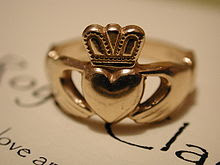 | |||||||||
| The Claddagh Ring - Traditional Irish Ring worn as Wedding Ring |
The wearing of a Claddagh ring in modern usage is usually intended to convey the wearer's romantic availability, or lack thereof. The ring is worn on the right hand with the heart oriented away from the wearer, to show that the wearer is not romantically linked. When turned the other way, it shows that the wearer is in a relationship, or their heart has been "captured". When worn on the left hand with the heart oriented again away from the wearer, it implies the wearer is engaged; turned the other way, it indicates the wearer is married.
Tuesday, March 16, 2010

Wednesday, March 10, 2010
Clearance Jewelry

From men's jewelry to women's jewelry to wedding sets, we have it all and all at an amazing price! While you're shopping our clearance jewelry make sure and check out the rest of our store, we are one of the only online jewelers to offer MAKE AN OFFER on all our regular priced items! More about make an offer to come later. Enjoy the site and let Judy or myself know if you have questions!
Ta Ta for now!
CaraLee - (360)-668-2658
Wednesday, March 3, 2010


Monday, November 10, 2008
October Birthstone - Opal & Pink Tourmaline

October Birthstone Opal
Birthstone: Opal
Moh's hardness: 5 1/2- 6 1/2
Specific Gravity: 2.50
Color: All colors, partially play-of-color Chemical Composition: SiO2, nH2O, hydrous silcon dioxide
Shop Our OPAL Jewelry
The Opal treats the eye to an explosion of shimmering colors, not unlike those of a magnificent rainbow following a summer rain. The Opal derives its name from the Latin word "opalus," meaning precious jewel. Prized for its unique ability to refract and reflect specific wavelengths of light, the Opal was called "Cupid Paederos" by the Romans, meaning a child beautiful as love. One Legendary explanation for this gemstone's origin is that it fell from heaven in a flash of fiery lightning.
Opal dates back to prehistoric times. It is a non-crystallized silica, which is a mineral found near the earth's surface in areas where ancient geothermal hot springs once existed. As the hot springs dried up, layers of the silica combined with water, were deposited into cracks and cavities of bedrock, forming Opal. This gemstone actually contains up to 30% water, so it must be protected from heat or harsh chemicals, both of which will cause drying and may lead to cracking or loss of iridescence. Opal must also be guarded from blows, since it is relatively soft and breaks easily.
A gift of Opal is symbolic of faithfulness and confidence. The powerful energy radiating from this fiery gemstone will surely illuminate any occasion.
October Alternate Birthstone: Pink Tourmaline
Birthstone: Pink Tourmaline
Moh's hardness: 7-71/2
Specific Gravity: 3.32
Color: Pink
Shop Our PINK TOURMALINE Jewelry
Pink Tourmaline has the seemingly magical property of pyroelectricity.
Scientifically speaking, this means that when heated, the gem takes on a static electric charge, making it capable of attracting lightweight objects. No wonder this gemstone was revered for it's mystical properties centuries ago. Considered the "stone of the muse," it is believed to stimulate the creative process of it's wearer.
Pink varieties of Tourmaline range in color from pastel pink to ruby red and are mined in Brazil, Afghanistan, Burma, and India. A gift of this stone is symbolic of hope.
Sunday, November 9, 2008
Facts you should know about GOLD
Gold, recognizable by its yellowish cast, is one of the oldest metals used by humans. As far back as the Neolithic period, humans have collected gold from stream beds, and the actual mining of gold can be traced as far back as 3500 B.C., when early Egyptians (the Sumerian culture of Mesopotamia) used mined gold to craft elaborate jewelry, religious artifacts, and utensils such as goblets.
Golds aesthetic properties combined with its physical properties have long made it a valuable metal. Throughout history, gold has often been the cause of both conflict and adventure, the destruction of both the Aztec and Inca civilizations, for instance, and the early American gold rushes to Georgia, California, and Alaska.
About 65 percent of processed gold is used in the arts industry, mainly to make jewelry. Besides jewelry, gold is also used int the electrical, electronic, and ceramics industries. These industrial applications have grown in recent years and now occupy an estimated 25 percent of the gold market. The remaining percentage of mined gold is used to make a type of ruby colored glass called purple of Cassius, which is applied to office building windows to reduce the heat in the summer, and to mirrors used in space and in electroscopy so that they reflect the infrared spectrum.
Golds one drawback for use in industry is that it is a relatively soft metal. To combat this weakness, gold is usually alloyed with another member of the metal family such as silver, copper, platinum, or nickel. Gold alloys are measured by karats. A karat is a unit of equal to 1/24 part of pure gold in an alloy. Thus,24 karat (24k) gold is pure gold, while 18 karat (18K) is 18 parts pure gold to 6 parts other metal, 14 karat (14k)is 14 parts pure gold to 10 parts other metal, and 10 karat (10K) is 10 parts pure gold to 14 parts other metal. The less gold in jewelry the stronger the piece of jewelry is.
Golds aesthetic properties combined with its physical properties have long made it a valuable metal. Throughout history, gold has often been the cause of both conflict and adventure, the destruction of both the Aztec and Inca civilizations, for instance, and the early American gold rushes to Georgia, California, and Alaska.
About 65 percent of processed gold is used in the arts industry, mainly to make jewelry. Besides jewelry, gold is also used int the electrical, electronic, and ceramics industries. These industrial applications have grown in recent years and now occupy an estimated 25 percent of the gold market. The remaining percentage of mined gold is used to make a type of ruby colored glass called purple of Cassius, which is applied to office building windows to reduce the heat in the summer, and to mirrors used in space and in electroscopy so that they reflect the infrared spectrum.
Golds one drawback for use in industry is that it is a relatively soft metal. To combat this weakness, gold is usually alloyed with another member of the metal family such as silver, copper, platinum, or nickel. Gold alloys are measured by karats. A karat is a unit of equal to 1/24 part of pure gold in an alloy. Thus,24 karat (24k) gold is pure gold, while 18 karat (18K) is 18 parts pure gold to 6 parts other metal, 14 karat (14k)is 14 parts pure gold to 10 parts other metal, and 10 karat (10K) is 10 parts pure gold to 14 parts other metal. The less gold in jewelry the stronger the piece of jewelry is.
Saturday, November 8, 2008
June Birthstones - Pearl & Alexandrite

Pearl & Alexandrite Education - June Birthstone
Birthstone: Pearl
Moh's hardness: 2 1/2 - 4 1/2
Color: White, pink, silver, cream, golden- colored, green, blue, black
Chemical Composition: Calcium carbonate,organic substances and water.
Shop our Pearl Jewelry
From one of the humblest of life forms, the mollusk, comes the Pearl, a gem of unsurpassed beauty and elegance. Ancient civilizations had many stories to explain the origin of June's birthstone, such as the Greek belief was that Pearls were the hardened tears of joy that the goddess of love shook from her eyes. According to Arab legend, pearls were formed when oysters were lured from the depths of the ocean by the beautiful moon and then swallowed moonlit dewdrops, and the Ancient Chinese thought that these gems originated from the brains of dragons.
The scientific explanation for natural pearls is almost as mystifying as folklore.
When an irritant, such as a small parasite or a fish lodges in the flesh of the oyster, mussel, or clam, a protective substance called "nacre" is produced.
Over years, layer upon layer of shimmering nacre coats the intruder, creating a lustrous pearl. Natural pearls are relatively rare, so a process evolved in which a piece of shell or bead was placed inside the mollusk to stimulate the production of nacre. This results in a cultured pearl, which accounts for about 90 percent of the pearl industry.
Pearls have been a passion and even an obsession of people throughout the ages. They have been ground up and used in cosmetics and as medicine to treat heart and stomach conditions. Some cultures swear by pearls as an aphrodisiac. These gems have adorned crowns, clothing, and temples, and where said to be a favorite of Cleopatra.
June Birthstone Alternate: Alexandrite
Birthstone: Alexandrite
Moh's hardness: 8 1/2
Specific Gravity: 3.78
Color: Color changing stone from, green
to red, blue-green, to purplish-red
Chemical Composition: BeAl2o4 beryllium
aluminum oxide
Shop Our ALEXANDRITE Jewelry
Alexandrite is one of the rarest gemstones. It is named after the Russian tsar Alexander II (1818-1881) the very first crystals having been discovered in April 1834 in the emerald mines near the Tokovaya River in the Urals.
The discovery was made on the day the future tsar came of age. Although Alexandrite is a relatively young gemstone, it certainly has a noble history.
Since it shows both red and green, the principal colors of old Imperial Russia, it inevitably became the national stone of tsarist Russia.
Beautiful Alexandrite in top quality, however, is very rare indeed and hardly ever used in modern jewelry. In antique Russian jewelry you may come across it with a little luck, since Russian master jewelers loved this stone. Tiffany's master gemologist George Frederick Kunz (1856-1932) was also fascinated by Alexandrite, and the jeweler's firm produced some beautiful series of rings and platinum ensembles at the end of the 19th and beginning of the 20th century. Smaller Alexandrites were occasionally also used in Victorian jewelry from England.
The most sensational feature about this stone, however is its surprising ability to change color. Green or bluish-green in daylight, Alexandrite turns a soft shade of red, purplish-red or raspberry red in incandescent light. This unique optical characteristic makes it one of the most valuable gemstones of all, especially in fine qualities.
Alexandrite is very scarce, this is due to its chemical composition. It is basically Chrysoberyl, a mineral consisting of colorless or yellow transparent Chrysoberyl.
Friday, November 7, 2008
Emerald Education - May Birthstone

May Birthstone Emerald
Birthstone: Emerald
Moh's hardness: 7.5-8
Specific Gravity: 2.78
Color: Emerald green, green, slightly
yellowish-green
Chemical Composition: Al2,Be3,Si6,O18,
aluminum beryllium sillcate
Shop Our EMERALD Jewelry
The name Emerald derives from Greek smaragdos. It means "green stone" and, in ancient times, referred not only to Emeralds but also probably to most green stones.
Emerald is the most precious stone in the beryl group. Often the Emerald is clouded by inclusions. These are not necessarily classified as faults, but are evidence as to the genuineness of the stone as compared with synthetic and other imitations. The experts refers to these inclusions as jardin ( French---garden)
Emeralds are always green, if the stone has too much blue in it, then it is Aquamarine. Pink beryl is Morganite, yellow beryl is Golden Beryl, yellow-green beryl is Heliodor. There is also a rare red beryl. An Emerald of the right shade of green can be more valuable than a Diamond.
Folklore has it that Emerald can help heal the physical heart as well as love. Emerald will help backaches when worn on the index finger of the left hand. Some cultures thought the Emerald would heal any disease of the eye, and others thought that the Emerald was a stone of great harmony, wisdom and love. Giving your lover an Emerald will bring the lover closer if the givers motives are pure love.
Thursday, November 6, 2008
April Birthstone - Diamond

April Birthstone Diamond
Birthstone: Diamond
Moh's hardness: 10
Specific Gravity: 4.1
Color: Colorless, yellow,orange, brown, black
rarely red, blue, green, pink and purple
Chemical Composition: C, crystallized carbon
Shop Our DIAMOND Jewelry
Diamonds are the hardest substance on earth. They are more brilliant than any other natural gem. Their fire, durability, and rarity make them the most prized of gems.
The most popular diamonds are colorless. However, most diamonds have a light tint, usually yellowish or brownish. Yellow diamonds as of recently have gained popularity and are commonly available. Perfectly clear diamonds are much more valuable than tinted diamonds. Very rarely, diamond occurs in deep hues of red, blue, and green. Such diamonds, known as "fancies", are extremely valuable.
Only 20 percent of mined diamonds are used in jewelry, as most are unsuitable.
A flawless diamond is exceptional, even diamonds used as gems contain flaws.
A grading system instituted by the GIA (Gemological Institute of America), was implemented to evaluate diamonds based on their clarity. Three additional evaluation systems were devised by the GIA. This leads to the four attributes, known as "the four C's", in which diamonds are evaluated. The four C's are, Color, Cut, Clarity, and Carat weight.
Many gems resemble diamond. However, only few have a luster and fire similar to diamond. The closest to the Diamond is the created Moissanite.
Wednesday, November 5, 2008
Amethyst Education - February Birthstone

February Birthstone Amethyst
Birthstone: Amethyst
Moh's hardness: 7
Specific Gravity: 2.65
Color: Various shades of Purple
Chemical Composition: Si02, silicon dioxide
Shop Our AMETHYST Jewelry
Amethyst is the purple variety of the quartz family, and the most valued member of of the quartz family. It must be purple to be Amethyst, but it can display a range of shades including deep purple, light lilac, lavender, and mauve. Top quality Amethyst is a deep medium purple with rose-colored flashes. It's purple color made it a stone of royalty for many thousands of years.
Amethyst can occur as crystals that are six sided on either end. It also forms as drusy which are crystalline crusts covering the host rock. It is found inside geodes and in allucial deposits all around the world and occurs in both crystalline or massive forms.
When manganese is present in clear quartz Amethyst is produced, while the amount of iron contained in the specimen accounts for the depth of purple.
Most Amethyst gemstones on the marked today are heat treated to produce a deeper color. Heat treating is permanent and these stones will not fade over time. Unless otherwise stated assume that any Amethyst you purchase today has been heat treated to increase the depth of color. Also note that most Citrine available on the market today is actually heat treated Amethyst.
Folklore has it that Amethyst has been used to guard against drunkenness and is thought to be helpful in overcoming addiction. It has been used for hearing disorders, insomnia, headaches and other pain. Some sources suggest it is used to stabilize mental disorders.
Tuesday, November 4, 2008
Citrine Education - November Birthstone

Birthstone: November
Moh's hardness: 7
Specific Gravity: 2.65
Color: Light yellow to dark yellow
golden brown, brownish red
Chemical Composition: SI02,silicon dioxide Refractive Index: 1.544-1.553
Shop Our Citrine Items
The name Citrine comes from an old French word, "citrin", meaning lemon.
Citrine is as warm as a Van Gogh painting of Sunflowers, it is one of the more rare forms of quartz. This gemstone ranges in color from the palest yellow to a dark amber named Madeira because of its resemblance to the red wine.
The Romans were thought to be the first to wear the yellow quartz, crafting it into cabochon, or highly polished but unfaceted cuts of stone set into jewelry. Citrine became more popular during the Romantic Period, when artisans often favored these warm colored gems to enhance gold jewelry.
Citrine, like all forms of quartz, was believed to have magical powers.
Folklore has been said that Citrine is believed to help the heart, kidney, digestive tract, liver and muscles. It was also said that Citrine promotes creativity, helps personal clarity and eliminates self destructive tendencies .
Most Citrine is heat treated to bring out the color. Natural colored Citrines are found in Brazil, Madagascar,Spain and Scotland. Well colored Citrine are used as stones for rings and pendants, less attractive stones are made into necklaces or ornaments.
Monday, November 3, 2008
Garnet Education - January's Birthstone

Birthstone: January
Moh's hardness: 61/2-71/2
Specitic Gravity: 3.36-4.20
Color: red,orange,brown,green,yellow
Chemical Composition: Mg3,Al2,(Si04)3,
magnesium aluminium silicate Refractive Index: 1.720-1.756
Shop All Our Garnet Jewelry
Garnet is a naturally occuring gemstone. Its name comes from Latin Granatus meaning seed, because it often resembles small round seeds when found in its matrix rock.
Rather than a single gemstone, garnet is a family of related minerals, some of which occur as gemstones. Each has a common crystal structure, and similar chemical composition. The popular understanding of garnet is as an inexpensive dark red stone. Because it is realtively common, it is often thought of as "only garnet", and being inferior.
Not known to the general public as a rule, there are 3 rarer kinds of Garnet that are outstanding. Tsavorite Garnet, is a bright beautiful green, sometimes mistaken for fine Emerald. It's color being induced by the presence of Chromium. This is one of my favorite stones. The next Topazolite, a name used for a variety of garnet with a with a topaz-yellow or an olive green color, and the final is Magnetism, is a type of Garnet, particularly the reddish "African" garnets, which are usually found in close association with diamonds, showing distinct magnetism.
Wednesday, October 29, 2008
December Birthstones - Blue Topaz, Tanzanite & Turquoise

Decembers Birthstones Blue Topaz, Tanzanite, & Turquoise
Birthstone: Blue Topaz
Moh's hardness: 8
Specific Gravity: 3.57
Color: Blue
Chemical Composition: Al2,Si04,(F0H)2,fluor containing aluminum silicate
Shop Our BLUE TOPAZ Jewelry
Blue Topaz is derived from the Sanskirt word "tapas" meaning fire. Blue Topaz is the hardest of the silicate minerals. While pure Topaz is colorless, the blue hue is created when Topaz is heated, whether the heat source is natural or engineered by man. The three shades of Blue Topaz are Sky, Swiss, and London Blue. The latter is the deepest blue and often used as a less expensive substitute for Sapphire.
Topaz is found primarily in Brazil, Nigeria, Sri Lanka, Mexico, Pakistan, China, and the United States.
A gift of Blue Topaz is symbolic of love and fidelity. Luckily, this cool blue gemstone has no legendary power to put out the burning flame of love.
Birthstone: Tanzanite
Moh's hardness: 61/2-7
Specific Gravity: 3.35
Color: Sapphire Blue, Amethyst, Violet
Chemical Composition: Ca2,Al3,Si04,30H, calcium aluminum silicate
Refractive Index: 1.691-1.700
Shop our TANZANITE Jewelry
Tanzanite was first found in the late 1960's at what remains the sole source, a hilly area called Merelani in Tanzania. So unlike many other gemstones, it does not carry a mystical ancient history. The name was changed from "blue zoisite" to Tanzanite by Tiffany & Company. This gemstone was introduced in the world market in the year 1969.
The Tanzanite gemstone shows a trichroic effect that is a 3 color visibility when viewed from different angles. The three color effects are blue, purple, and bronze. Legend has it that, the first pieces of Tanzanite was collected by the Masai herders when they noticed lightning strike some brownish ziosite crystals. The lightning is supposed to have changed the crystal to a beautiful blue color.
Tanzanite is almost always heat treated. The natural color of Tanzanite is brownish and this is how most rough Tanzanite appears. Heating of Tanzanite results in color change that ranges from Blue to Purple. Color enhancement using heat treatment is a widely accepted treatment for the Tanzanite gemstone.
Birthstone: Turquoise
Moh's hardness: 5-6
Specific Gravity: 2.84
Color: Sky-blue, blue-green, apple-green
Chemical Composition: CuAl6, P04,40h 8 4H20; a copper containing basic aluminum phosphate
Refractive Index: 1.610-1.650
Shop Our TURQUOISE Jewelry
Turquoise with its blue hue is among the oldest known gemstones. Turquoise was obtained from the Sinai Peninsula before the 4th millennium BC in one of the world’s first important hard rock mining operations. Turquoise started being used before 4000 BC. Turquoise was a important ornamental mineral for jewelry and other objects by ancient Egyptians. It graced the necks of Egyptian Pharaohs and adorned the ceremonial dress of early Native Americans.
The name Turquoise means "Turkish stone" because the trade route that brought it to Europe used to come via Turkey. Pure blue color is rare, mostly turquoise interspersed with brown, dark gray or black veins of other minerals or the host rock. Such stones are called turquoise matrix.
Turquoise is said to be a guard against all diseases. It assists in tissue regeneration, subtle body alignment & strengthening. Turquoise is also believed to bring the wearer happiness and good fortune.
Anniversary Jewelry Gift Ideas
Anniversary Jewelry Gift List
Year 1 ----Gold Jewelry or Fresh Water Pearl Jewelry
Year 2-----Garnet or Rose Quartz Jewelry
Year 3-----Pearl or Crystal Jewelry
Year 4-----Blue Topaz or Amethyst Jewelry
Year 5-----Sapphire or Turquoise Jewelry
Year 6-----Amethyst or Garnet Jewelry
Year 7-----Onyx, Cooper, or Lapis Jewelry
Year 8-----Tourmaline, or Bronze Jewelry
Year 9-----Lapis Lazull or Tiger Eye Jewelry
Year 10----Diamond or Onyx Jewelry
Year 11----Turquoise or Hematite Jewelry
Year 12----Jade or Agate Jewelry
Year 13----Citrine, Malachite or Moonstone Jewelry
Year 14----Opal, Ivory or Moss Agate Jewelry
Year 15----Ruby or Crystal Jewelry
Year 16----Peridot or Aquamarine Jewelry
Year 17----Amethyst or Citrine Jewelry
Year 18----Chrysoberyl or Opal Jewelry
Year 19----Topaz or Aquamarine Jewelry
Year 20----Emerald or Platinum Jewelry
Year 21----Iolite Jewelry
Year 22----Spinel Jewelry
Year 23----Imperial Topaz or Sapphire Jewelry
Year 24----Tanzanite Jewelry
Year 25----Sterling Silver Jewelry
Year 30----Pearl Jewelry
Year 40----Ruby Jewelry
Year 50----Solid Gold Jewelry
Year 60----Diamond Jewelry
Year 75----BIG Diamonds
Tuesday, October 28, 2008
Colored Diamonds - A Fall Trend

The new wave in the jewelry industry and the fashion world is Colored Diamonds, which have become extremely popular over the last 3 years. In light of the growing interest in color diamonds it is important to clear the confusion between treated and natural color diamonds.
Technological developments now allow us to create diamonds of almost any color, either completely artificially or from natural Diamonds whose color is unattractive not clearly defined, yellowish, brownish etc. Such stones can be manufactured at will, resulting in the production of goods that are the exact contrary of what they are substituting for, diamonds by definition are unique, rare, and exceptional.
A natural Colored Diamond is unique. It is a product of nature, shaped by millions of years of crystallization. Its color is the product of chance and not two natural color diamonds can be identical, it is this uniqueness, this rareness that gives them all their value, and a high price tag. Natural Colored Diamonds are considered like any authentic work of art.
Diamonds that are treated to bring out there basic color on the other hand, still have a exquisite look and are unique on their own, with a much more affordable price tag to the consumer. The Colored Diamond Jewelry that OldCities offers has treated Diamonds. Please feel free to look at our fine collection, and let us know if you have any questions, 360-668-2658.
Monday, August 11, 2008
Ruby Eduction - July's Birthstone

Birthstone: July
Moh's hardness: 9
Specific Gravity: 3.97-4.05
Color: Varying red
Chemical Composition: Al2O3 aluminum oxide
Refractive Index: 1.762-1.778
Shop ALL Our Ruby Jewelry
Two color varieties of curndum are used for making jewelry, the red ruby and the sapphire. Common corundums i.e. those not of gemstone quality serve as cutting and polishing material. The well-known polishing material emery is mainly fine-grain corundum, to which magnetite, hematite and quartz are added. The name corundum has its origin in India and probably referred to ruby.
Ruby is named because of its red color. It was not until about 1800 that ruby, as well as sapphire, was recognized as belonging to the corundum species. Before that date, red spinel and the red garnet were also designated as ruby.
The red color varies within each individual deposit, so it is not possible to determine the source area from the color. The designation "Burma ruby" or Siam ruby" are therefore strictly erroneous and refer more to quality than origin. The most desirable color is the so-called "pigeons blood", pure red with a hint of blue. The distribution of color is often uneven, in stripes and spots. The substance that provides the color is chromium and in the case of brownish tones, iron is present as well. AS a rough stone ruby appears dull and greasy but when cut the luster can approach that of a diamond. Heat treatment is commonly used to improve the color.
Ruby is the hardest material after diamond. Inclusions are common. They are not always indicative of lower quality, but show the difference between natural and synthetic stones. The type of inclusion {minerals, growth structures, canals, or other cavaties} often indicates the source area.
Thursday, August 7, 2008
Sapphire Education - Septembers Birthstone

Birthstone: September
Moh's hardness: 9
Specific Gravity: 3.95-4.03
Color: Blue in various tones, colorless, pink, orange, yellow, green, purple, black
Chemical Composition: Al2O3 aluminum oxide
Refractive Index: 1.762-1.788
Shop Our SAPPHIRE Items
The name sapphire {greek means blue} used to be applied to various stones. In antiquity and as late as the Middle Ages, the name sapphire was understood to mean what is today described as lapis lazuli. Around 1800 it was recognized that sapphire and ruby are gem varieties of corundum. At first the blue variety was called sapphire and corundums of other colors {with the exception of red} were given special, misleading names, such as "oriental peridot" for the green variety or "oriental topaz" for the yellow type.
Today corundums of gemstone quality of all colors except red are called sapphire. Red varieties are called rubies. The various colors of sapphire are qualified by description, e.g. green sapphire or yellow sapphire. Colorless sapphire is called leuko-sapphire {greek means white}, pinkish orange sapphire Padparadscha.
There is no definite demarcation between ruby and sapphire. Light red, pink or violet corundums are usually called sapphires, as in this way they have individual values in comparison with other colors. If they were grouped as rubies, they would be stones of inferior quality. The coloring agents in blue sapphire are iron and titanium; and in violet stones, vanadium. A small iron content results in yellow and green tones; chromium produces pink, iron and vanadium orange tones. The most desired color is a pure cornflower-blue. In artificial incandescent light, some sapphires can appear to be ink-colored or black-blue.
Through heat treatment at temperatures of about 3100-3300 degrees F {1700-1800 degrees C}, some cloudy sapphires, non distinct in color, can change to a bright blue permanent color.
Hardness is the] same as ruby and also differs clearly in different directions {an important factor in cutting. There is no fluorescence characteristics for all sapphires. Inclusions of rutile needles result in a silky shine; oriented, i.e. aligned, needles cause a six-rayed star sapphire.
Thursday, July 31, 2008
Onyx - August's Alternate Birthstone

Onyx: comes in many forms, from sardonyx, to cameo's, to intaglio's, to cabochons, and many more forms.
Birthstone: August
Moh's hardness: 7
Specific Gravity: 2.65 - 2.66
Color: Black, white, green, brown, red
Chemical Composition: SiO2 - Silicon Dioxide
Refractive Index: 1.543 - 1.552 to 1.545 - 1.554
Onyx is a layer stone with the combination of a black base and white upper layer also called true onyx or Arabic onyx. In cabochons and beads, black and white layers may alternate. On the other hand, onyx is also a name sometimes used for unicolored chalcedony. This must not be confused with onyx marble, which in short is also called onyx. The name onyx has its origin in the Greek language and means "fingernail" probably because of its weak transparency.
Onyx Intaglio: name for engraving with negative image into that stone, as used for seals.
Onyx Cameo: name for a relief which is cut so that it is raised, usually the bottom layer being a dark color while the relief being carved out of the white layer on top.
SHOP OUR ONYX JEWELRY
Subscribe to:
Posts (Atom)